On my 2026 goals recap post, Engie commented, “So many goals! How do you track all of this? Have you talked about that before?”
I was mentally writing out a very long comment to her as I thought about how to respond and figured, why not make it a blog post? So that’s what you get today!
This probably won’t please many people, but I have to admit that I have relied on ChatGPT a fair bit to help me put together the right habit-tracking system for myself. I have a LOT of goals I’m tracking this year, and I would absolutely fall apart if I didn’t have a system for keeping track of everything.
Here’s how it works:
Daily
Most of the goals I’m tracking are daily habits:
- Drink water
- Close my Apple Watch rings
- Take meds
- Text one friend
- Do my morning/evening routines
- Move my body
- Get outside
For these goals, I bought a habit tracker pad on Amazon. There are a million of these, but this is the one I have, and I like it a lot!
It’s part of my evening routine to go down the list of daily habits I’m tracking and mark off which ones I did that day. I keep this pad on the breakfast bar that’s visible right when you walk into my apartment, so it’s something I see often. I really enjoy making those checkmarks every evening! And it’s quick – just takes a few seconds at the end of the day.
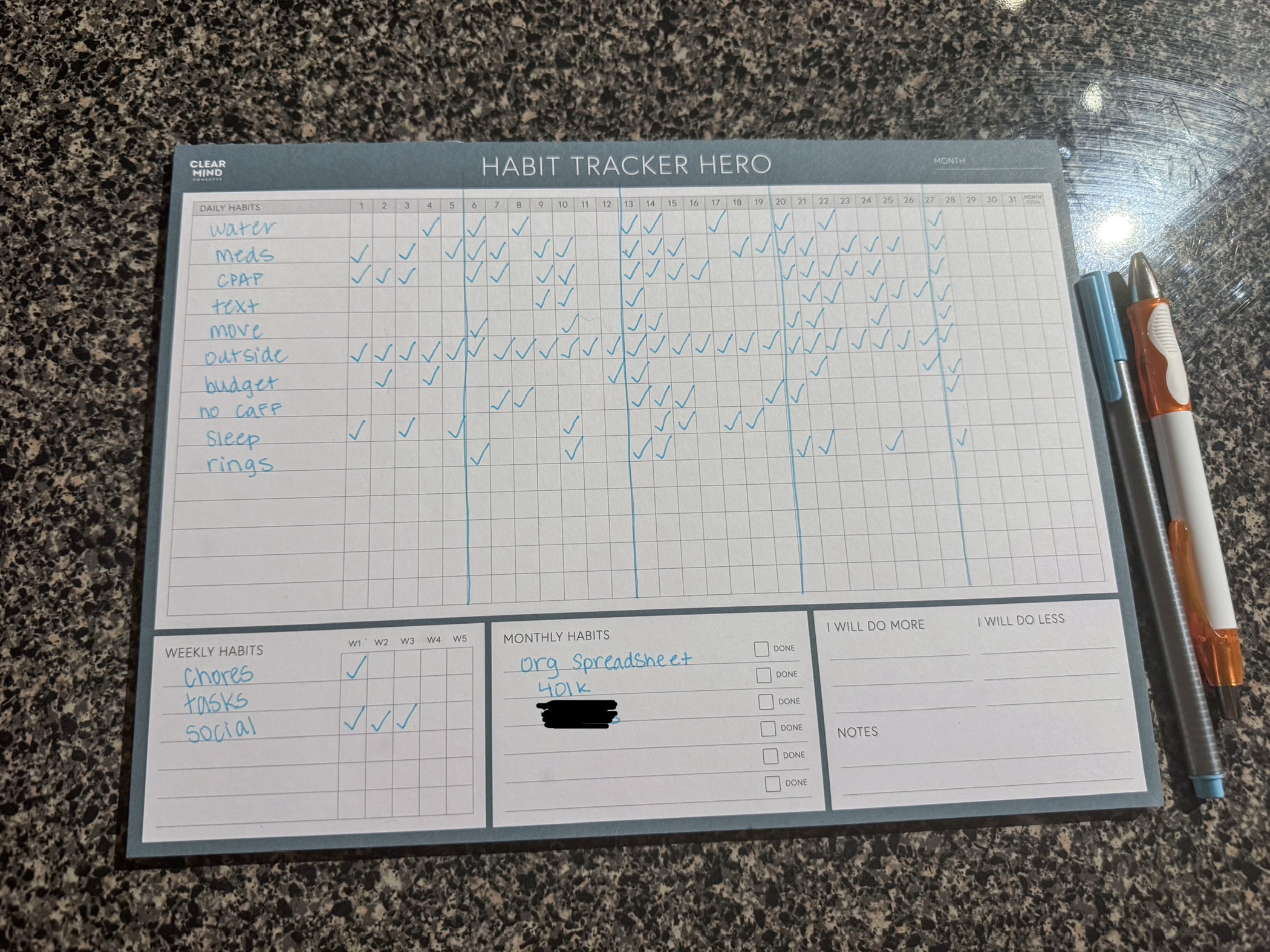
(I draw a line to separate the weeks, so it’s easier for me to visualize!)
Weekly
I have a list of weekly admin tasks that I typically do every Sunday. On that list are things like “set up my budget for the week” and “refill med organizer.” There’s also the task of “review goals.”
And that’s when I sit down at my laptop with my habit tracker pad and fill out a spreadsheet that ChatGPT made for me. It’s the kind of spreadsheet that is easy to use but way too complicated for me to put together myself. (I am not an Excel whiz!)
The first tab of my spreadsheet is called my “Daily Tracker.” It’s broken down by day (starting April 1st, since I didn’t start this process until Q2), and then I have each goal listed as the column heading and a simple “no/yes” dropdown. The goals on this spreadsheet mirror what’s on my habit tracker pad (although I add a few extra habits to track every month, just for funsies), so I just go down the list and fill in the answers for the week.
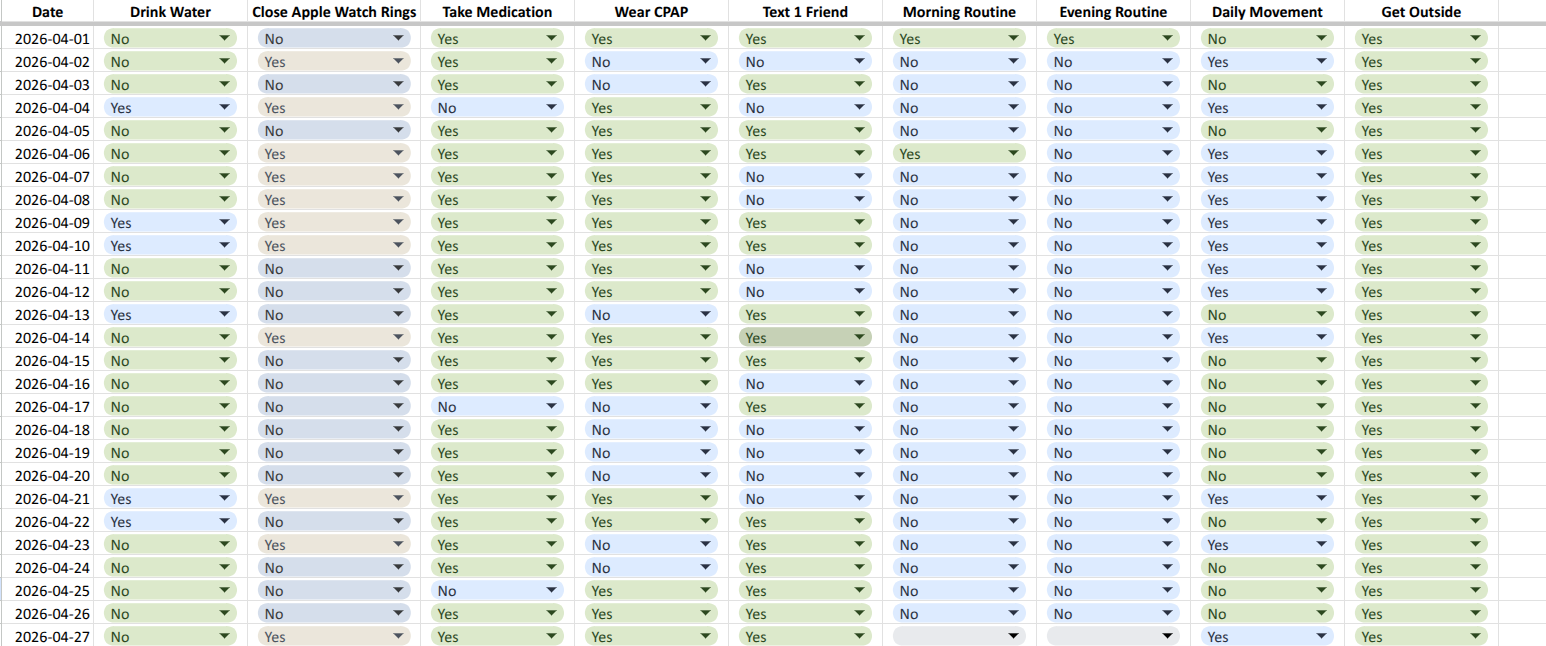
The second tab is called “Monthly Goals.” This is where I track goals that don’t need daily attention, like:
- Send three pieces of snail mail
- Watch one season of a TV show, listen to one album, and watch one movie
- Visit a new-to-me spot in my town every month
I click over to this tab every week in case there’s something I can fill in, like visiting a new spot or sending postcards. I also have a list at the bottom where I’m tracking my weekly goal of making plans with friends.
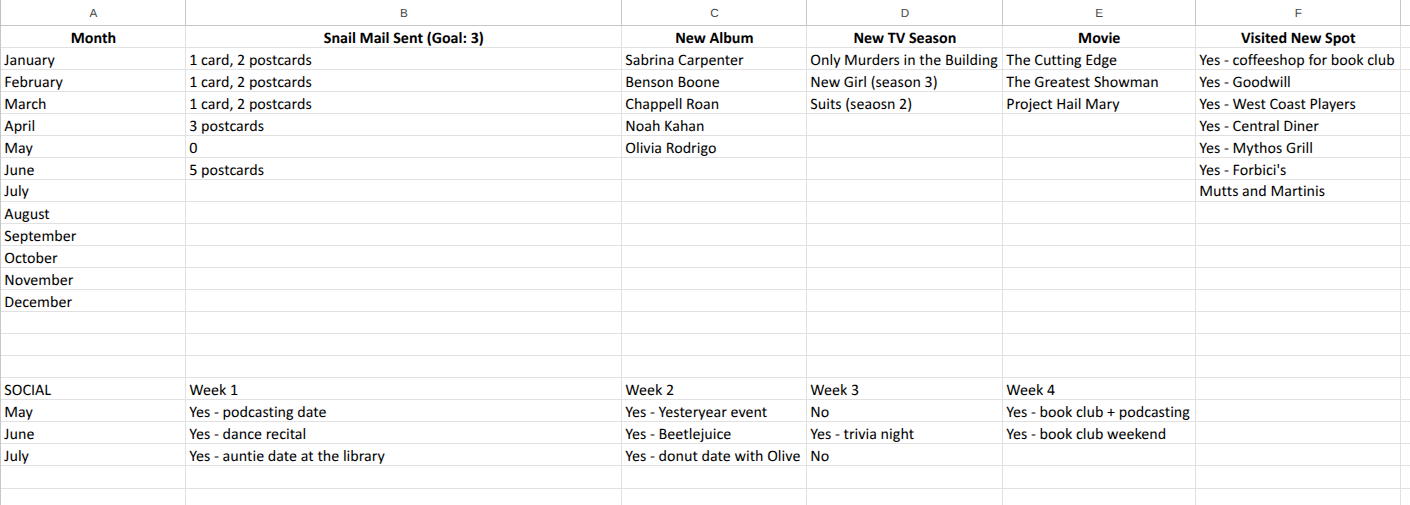
Again, this process does not take very long, and there’s a reason why it’s something I love to do every Sunday, which I’ll take about in a moment.
(I’m happy to give people a copy of my spreadsheet so they can make one of their own!)
Quarterly
I only really look at my numbers and figure out percentages every quarter, when I’m putting together my annual goals recap post. Should I maybe look at this tab more often to see where I can make adjustments? Probably, but I tend to do that during my weekly review session, where I can see which goals have been a struggle more than others.
And that’s when I visit the third tab of the spreadsheet, called “Monthly Dashboard.” It pulls in all of the data from the Daily Tracker tab and shows me how many times I’ve done each habit for the corresponding month. (I’m sure there’s a way I could get the spreadsheet to spit out percentages, but it’s not that much work to figure them out myself.)
So, when you break it down:
- Daily = checking off boxes on my habit tracker pad
- Weekly = updating my habit tracker spreadsheet
- Quarterly = actually analyzing how I’m doing on my goals
My Reward System
I find it very easy to sit down every week and input my goals into my spreadsheet because I set up a reward system for myself! Of course I did. Depending on how many times I marked “yes” on a daily goal that week, I get a reward:
- 7 days = 2 gold stars
- 6 days = 1 gold star
- 5 days = 1/2 gold star
- 4 days = 1/4 gold star and $5 into savings fund
- 3 days = $5 into savings fund
- 2 days = $10 into savings fund
- 1 day = $15 into savings fund
- 0 days = $25 into savings fund
I have a legit piece of paper that I use to keep track of my gold stars. Whenever I reach 10 gold stars, I can buy something from my Etsy or Amazon wish list. (My next reward is going to be Bluetooth sleep headphones to make falling asleep to my ASMR videos even more magical and a new luxurious bath pillow.) Sure, these are things I can buy without this reward system, but the reward system makes it so much more delightful!
The savings fund is also fun because I put that money into a “special” savings account where I save up for bigger purchases. I used this fund for my bedroom bench, the two new bookshelves I’ve added to my apartment, new running shoes, and soon… a reading chair!
You might think I wouldn’t be determined to mark off goals if I can put more money into savings the less I do something, but that’s not how my brain works. It makes me sad to part with my money, and I find adding gold stars to my chart to be a lot more rewarding. But if I find myself trying to “beat the system” at some point, I’ll rework things.
Final Thoughts
Is this system unnecessarily complicated? For some people, sure. But it scratches a very specific part of my brain. It is so satisfying to me to physically check things off, collect gold stars, and earn fun rewards. It makes goal-tracking and creating habits a lot more fun, too.
Do you have an unnecessarily complicated goal-tracking system like me?!

Wow this is amazing! I think some people will be horrified LOL but not me- I totally get how tracking things can be fun! I have used a habit tracking spreadsheet for years (though ironically, not really currently) that basically mirrors your habit tracker pad. I just always filled it out first thing in the morning when I sat down to check my Google Calendar (I had it in a Google Sheet, so easily accessible from my Google Cal). I do love the idea of a paper version though! I hadn’t seen those before and I think that could be super helpful for many people who prefer a quick check off option to say, keep by their bed.
I also like your monthly goals tab. I have struggled in the past to keep tabs on goals that are not daily, but more sporadic. Like the “do this 3x” type of thing. Your sheet makes it nice and visible!
Yes, it’s probably overkill to track my daily habits in two places but I just know it’s easier for me to have a physical place to check things off that I can then transfer to a spreadsheet.
Yes about the sporadic goals – like my goal of making plans with friends once a week or send 3 pieces of snail mail every month. It’s a hard thing to track unless you have a place for it!
I love it! I am very pro-tracking, or at least ‘try tracking it’ in life, and it’s so interesting to see which method work for different people. I especially love the pad! So simple + elegant but effective and easy to see progress! I probably would have used a diff color for each habit or type of habit, ha!!
What’s funny is that I STARTED to color-code the spreadsheet (the second row is a different color) and then I guess I got distracted and forgot to keep going?! I should go back and color-code it!
Wow, you have a good system, Stephany!! This is awesome. Obviously it works well for you!
My big goal of DNFing is going well but I am sorry to tell you…I had to DNF The Kiss Quotient. I almost didn’t tell you that, but I think I told you I started it so…it just wasn’t working for me. I’m sorry! I wanted to love it! It’s not every day there’s a romance that involves a female econometrician. Alas. I did read the acknowledgements and notes at the back and I loved the why of her writing the book. Now it’s on its way back to the library so I hope the next person loves it like you did!
Do not be sorry about DNF-ing The Kiss Quotient! I am not upset at all. It’s one of MY faves but not one I am precious about, haha. I’m glad you gave it a try and I’m also glad you DNF-ed it because you shouldn’t read a book you’re not loving!
Ha, no I wouldn’t say my system is “overcomplicated” but rather “rudimentary.” Maybe I would get more done if I had your system! It’s obviously working for you, and you enjoy it, so I would call it a success.
Thank you! I enjoy the nitty-gritty of stuff like this, so it’s fun for me!
That’s an impressive system, and how cool that you’ve figured out what works for you! I’ve always thought of you as someone who gets things done, and this explains why! I’m also impressed that you know what motivates you and that you reward yourself with “prizes.” Awesome!!
Wow, I take it as a HIGH COMPLIMENT that you consider me someone who gets things done. As long as I have a good system in place, I can make it happen!
I love this. I find that ticking things off gives me a buzz too. My spreadsheet to track my 101 Things is ridiculous, but so satisfying; it calculates my completed progress with where I need to be and highlights it in red or green, so I completely get this. My daily, weekly, monthly stuff I track in Obsidian, which is my main catch-all for notes, planning and everything else. I have done quite a bit of tweaking to track everything I want and have a few more ideas to implement once I have the time.
Oooh, have you talked about your tracking spreadsheet for your 101 Things?! I want to know more!
I haven’t heard of Obsidian, but I’m going to look into it!
I wanna be Stephany when I grow up.
Seriously, your system is amazing.
I write stuff down in my “accessory notebook” that accompanies me everywhere in conjunction with my calendar.
My daily goals are kind of like habits if you will?… 1. drink water first thing in the morning, before coffee, 2. take vitamins, 3. take medication, 4. check my calendar+accessory notebook 5. have protein within 30 minutes of waking.
Weekly… 1. exercise two-three times, weights, swimming, or a cycling class, 2. outside time+short walk or a small hike 3. keep up with weekly calendar tasks (kids activities, etc) 4. weekly lesson plans 😉 5. have actual cooked food: chicken, veggies, some kind of starch. 6.blog at least twice per week. 7 comment as much as I can.
Monthly…paint my nails and toes (I do my own).
Quarterly… Not sure…
This was thought-provoking, thank you!
You are so sweet! Thank you!
An accessory notebook – that’s kinda genius!
I need to paint my nails more often. I always love when I get back into that habit. It’s so fun picking out a new color each week!
Wow, what a fun system. I think the best thing one can figure out is how you can motivate yourself and what makes you tick. And for your it is obviously gold stars and a reward.
I remember I sat up something like that and I collect me some rewards I never really cashed in because I was lost on what I wanted. So obviously it is not working for me.