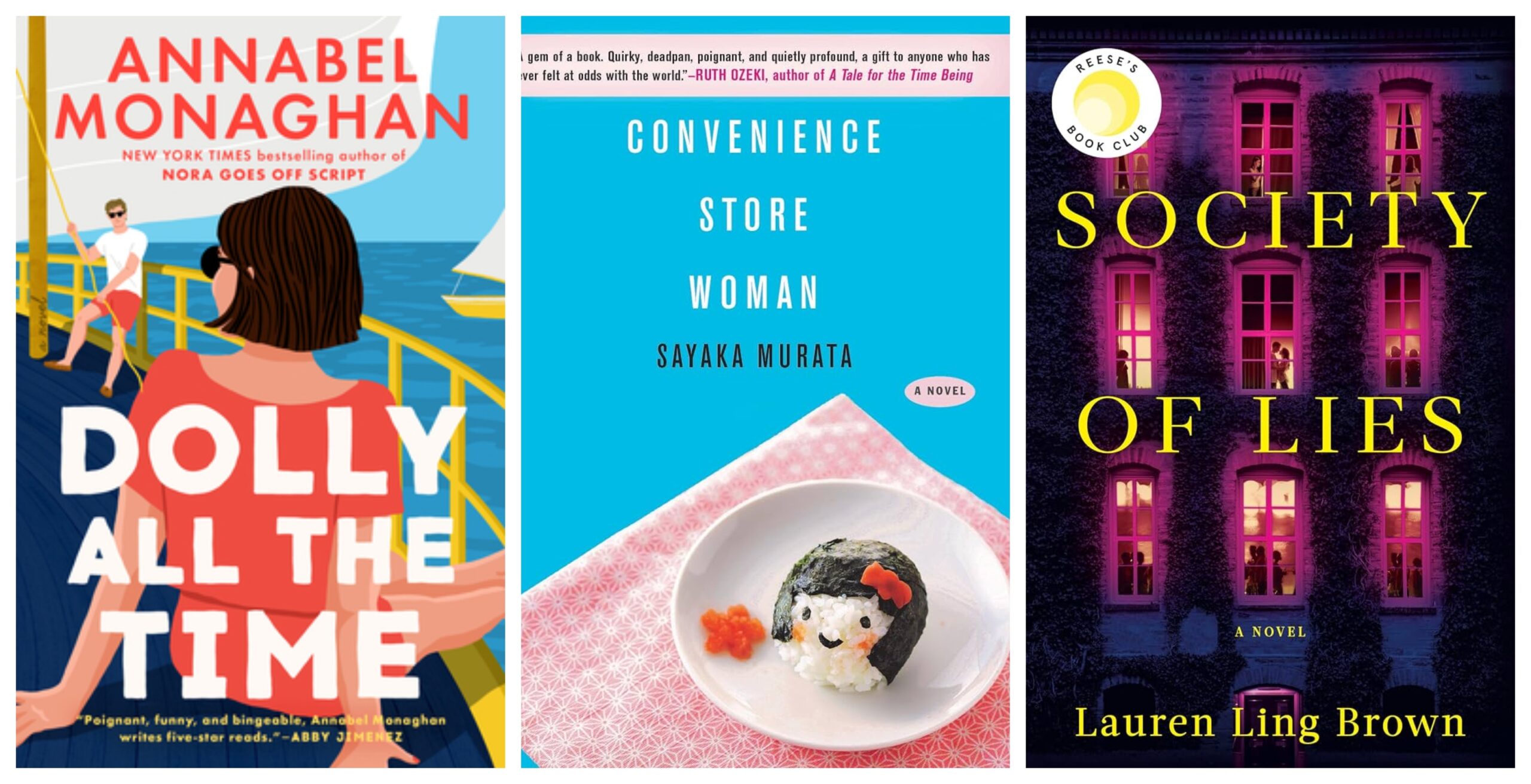
Dolly All the Time by Annabel Monaghan (★★★★☆)
Print • Owned (Barnes & Noble) • Contemporary Romance • 2026
Short synopsis: When Dolly Brick returns to her hometown to save her family’s home, an unexpected arrangement with a handsome heir and his very public heartbreak forces her to confront whether she’s finally ready to let someone else take care of her.
Oh, Dolly. What a fantastic character! I loved her so much. I can’t tell whether she is an Enneagram 9 or Enneagram 2 (leaning toward 2 because she seems more motivated by being needed by people than by keeping a peaceful environment), but she really struggles with voicing her own needs. She’s happy to give everything to her family if it means they are happy and fulfilled. There are so many small (but meaningful) ways that the author shows how Dolly minimizes herself to avoid being a burden. I loved the relationship between Dolly and Stewart and the slow but satisfying way things developed between them. Where the story lost me was with the dark moment; it felt deeply unkind and stretched on for far too long. Dolly deserved better, and I wish the author had made a different choice here. I still really loved the book, but I wanted better for Dolly at the end.
Convenience Store Woman by Sayaka Murata (★★★★☆)
Audiobook • Spotify • Contemporary Fiction • 2018
Short synopsis: Keiko, a socially unconventional woman who finds belonging and purpose working at a convenience store, struggles to maintain her carefully constructed version of normalcy when societal expectations pressure her to pursue a more traditional path.
I’ll admit that I have not had the best luck with CBBC books, but this one was a hit for me! I started the audiobook the day Engie published the first discussion post, so I was worried I wouldn’t be able to discuss in a timely manner, but I finished the audiobook in a day! There is a lot to unpack in this book, but what I really want to talk about is how much I related to Keiko. She has some eccentricities that I don’t have, and our neurodivergence is different, but I could wholly relate to this idea of wanting to seem normal, so you do things like pretend you have a boyfriend to get your sister off your case, even if the boyfriend is truly a loser. (Okay, so I’ve never done that, but I do know the feeling of, “Oh, look at me! I’m finally doing something that’s following the ‘right’ path!” when I’m dating someone seriously.) I think what’s interesting about Keiko’s story is that so many of us (me included) finished it wanting more from her. But isn’t that just our own societal expectations? Why do we think Keiko needs more? Why can’t she be happy and fulfilled working at a convenience store? Because, truthfully, Keiko seems happiest when she is doing her own thing, even if it doesn’t seem to be exactly what society deems as “normal.” (Also, I think Linda from Sky Daddy and Keiko would get along famously.)
Society of Lies by Lauren Ling Brown (★★☆☆☆)
Audiobook • Libby • Thriller • 2024
Short synopsis: When her younger sister Naomi dies under suspicious circumstances at Princeton, Maya begins investigating the elite social club they both belonged to, uncovering dark secrets from her own past and questioning whether her college experience—and the secrets she’s kept—may have led to her sister’s death.
I wanted to love this book. And I did… until the author got incredibly lazy with the ending, leaving me with messy plot holes and this “WTF did I just read” feeling. I loved the dark academia setting, and shifting between the timelines wasn’t too confusing. (There are three timelines: present day as Maya is investigating her sister’s death, the months before Naomi’s death, and Maya’s time at college a decade ago.) But as the story progressed, I started getting very confused as all sorts of plot holes emerged, and by the end, the author didn’t offer up any sort of satisfying ending. She just ended the book, and I was like, “But wait. What about this thing? And this thing? And this other thing?” If they were red herrings, I can accept that, but the author needs to show us why they were planted there. I also found it weird that the way Maya was written from Naomi’s point of view was so different from the way she presented herself in her own chapters. That’s not abnormal, of course, because we see ourselves differently than the way other people see us, but I was hoping for more resolution, or at least some acknowledgement on Maya’s part about the way she treated her younger sister. Alas, this book just wasn’t for me. Meh.
What are you reading?

Leave a Reply